Psalm 34 — Hebrew Acrostic and English Parallel Chart
Projects | | Links: Psalm 34 parallel chart (PDF)
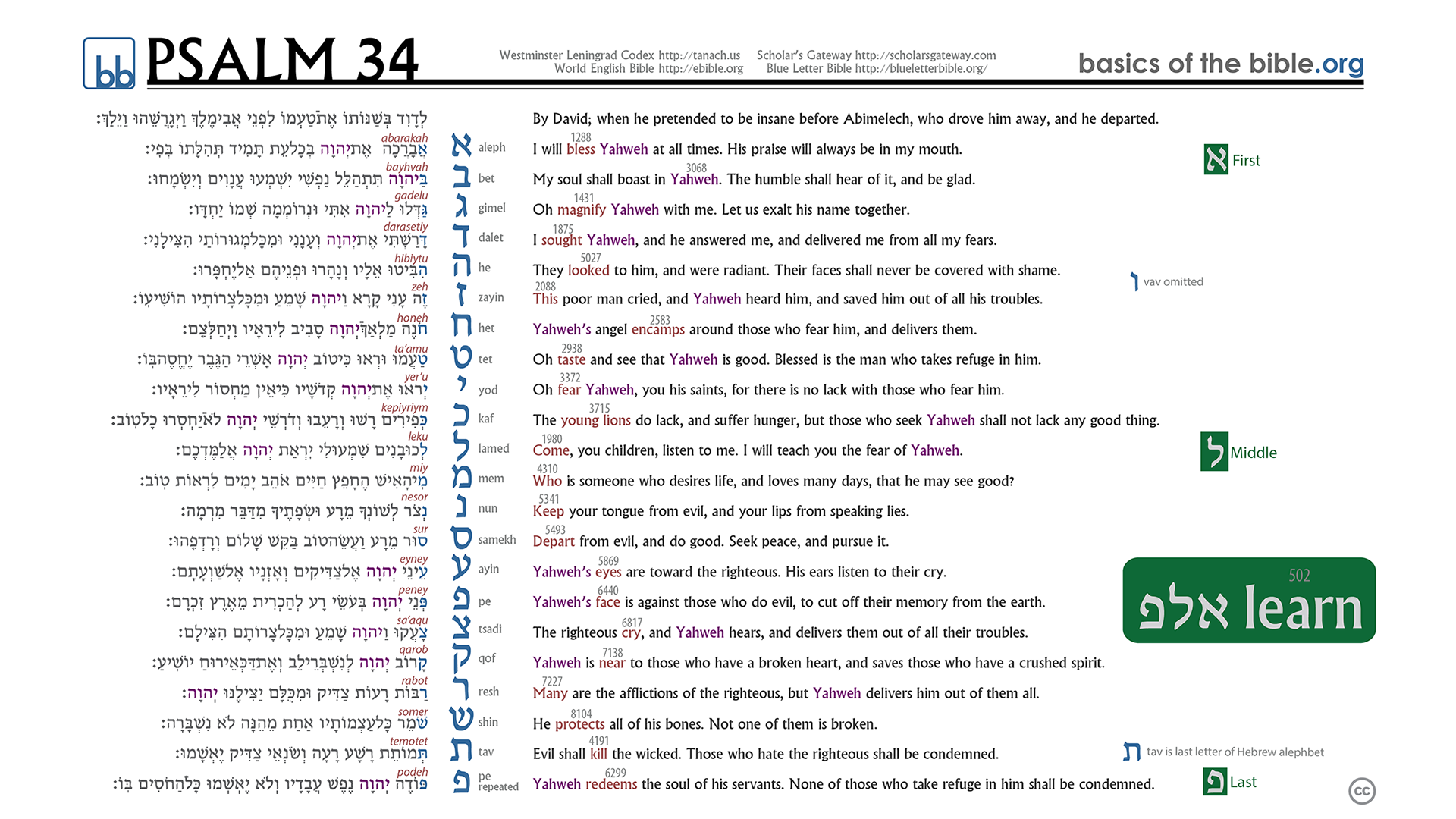
Follow Psalm 34’s Hebrew alphabetic pattern alongside English, with word highlights, transliterations, and annotations on omitted and repeated letters.
This chart places Psalm 34’s Hebrew text beside its English translation so readers can follow its acrostic: an arrangement of poetic units beginning with successive letters of the Hebrew alphabet. Blue letters identify the Hebrew initials, and red highlights connect the opening words with their English equivalents.
The alphabet column shows the omitted vav and additional final pe. Transliterations, Strong’s numbers, and links embedded in the PDF support further study.
Acrostic observations
Psalm 34 is one of several acrostic poems in the Bible (others include Psalms 9, 10, 25, 37, 111, 112, 119, and 145; Proverbs 31; and Lamentations).
In an alphabetic acrostic, successive Hebrew letters begin poetic units, which may be phrases, verses, or stanzas. The acrostic form is lost upon the reader when translated. Furthermore, the initial Hebrew word of each stanza is not necessarily the initial word when translated.
The author (David, as indicated in the opening stanza) of Psalm 34, as in Psalm 25, omits vav (presumably because there are only ten words in the Hebrew scriptures that begin with the letter vav), and adds an extra pe at the end. As John F. Brug proposes, this appears to be in order to form the Hebrew word אָלַף ‘alph from the first (aleph), middle (lamed) and last (pe) letters of the acrostic. אָלַף ‘alph translated into English means learn.
Reading the chart
In order to more fully appreciate the original structure of the psalm, the original Hebrew (Westminster Leningrad Codex) is shown line by line alongside the English translation (World English Bible). On the Hebrew side of the graphic, each initial letter of the acrostic is highlighted in blue, and a transliteration of the Hebrew is shown above the initial word in red italics. On the English side of the graphic, the translated word that corresponds to the initial word in each stanza is highlighted in red (matching the transliterated word). The Strong’s Number is shown above the highlighted word in gray. The Hebrew letters forming אָלַף ‘alph are shown in green. The Personal Name of the Creator God in the original Hebrew is יְהֹוָה Yahweh, most often translated in modern English versions as LORD (all capitals), is highlighted in this graphic in purple. David cries out to Yahweh in nearly three-quarters of the stanzas in this psalm. The other Hebrew word for the Creator God אֱלֹהִים elohiym is not used by David in Psalm 34. Finally, the PDF version of the graphic contains hyperlinks to Hebrew root parser and Strong’s Numbers from Scholar’s Gateway and Blue Letter Bible, respectively, allowing the viewer to further study the meaning of each word of the acrostic.
References
Brug, John F. Near Eastern Acrostics and Biblical Acrostics: Biblical Acrostics and Their Relationship to Other Ancient Near Eastern Acrostics. NEH Seminar: The Bible And Near Eastern Literature, Yale 1987, 1997 edition.
Strong, James. The New Strong’s Expanded Dictionary of Bible Words. Thomas Nelson Publishers, Nashville, Tennessee, 2001.
Downloads
Psalm 34 parallel chart (PDF) 1 page, legal landscape (14 × 8.5 in), 1.9 MB
Psalm 34 parallel chart (PNG) 1920 × 1080 pixels, 0.8 MB