Psalm 119 — Hebrew Acrostic with Word Highlights
Projects | | Links: Psalm 119 banner (PDF)
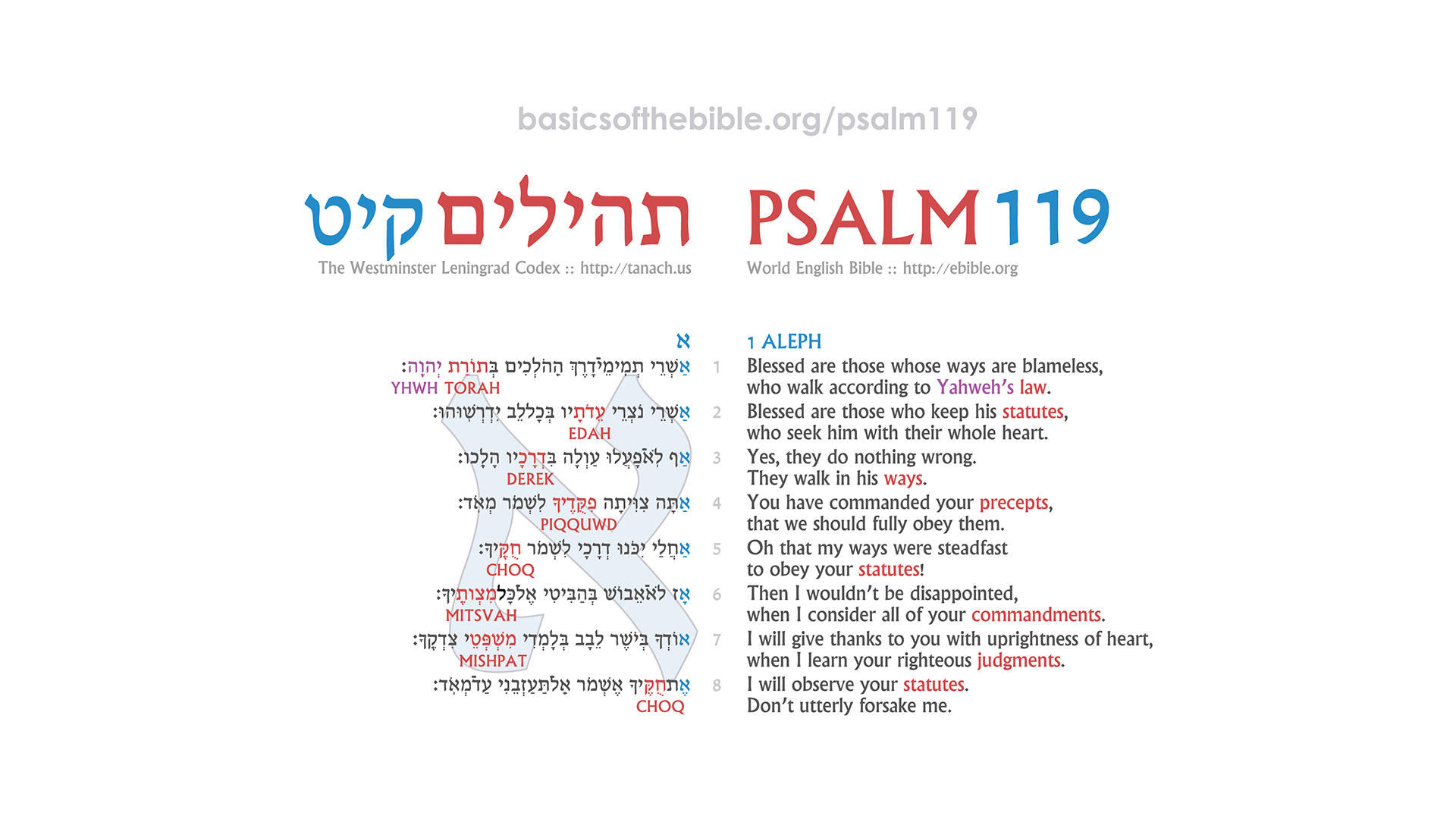
Explore Psalm 119’s 22 eight-verse sections in Hebrew and English, with recurring vocabulary highlighted in banner and widescreen formats.
I created this graphic to make Psalm 119’s Hebrew acrostic visible alongside its English translation. Its 22 sections follow the Hebrew alphabet; all eight verses in each section begin with the same letter.
Blue initials identify the acrostic pattern. Red highlights and transliterations connect recurring Hebrew terms with their English renderings, while separate colors distinguish the divine names. A frequency summary at the end records the highlighted vocabulary.
The Hebrew text is from the Westminster Leningrad Codex, with English from the World English Bible. Choose the banner for viewing the complete arrangement or the paginated widescreen version for reading and presentation.
Observations on Psalm 119
Psalm 119 is one of the most amazing passages in the Bible. We can miss a lot of the beauty and structure of Psalm 119 if we do not look at it in the original language it was written, Hebrew. This psalm is divided into 22 sections: one for each letter of the Hebrew alphabet. Each section is composed of 8 verses and each verse begins with the same Hebrew letter.
It is likely that this was for both aesthetics and as a memorization aid. This kind of poem is known as an acrostic.
Almost every verse contains a special word pertaining to Yahweh’s law, ordinances, word, commandments, statutes, precepts and decrees. In most cases, each verse contains a single instance of the special word; except in 6 cases where the verse contains two special words; and in 1 case (verse 122), where no special word occurs. The usual verse structure is AB, except in 3 verses with an A structure and 1 verse that adds a cry for help at the end of an AB structure.
The Name of the Creator God is used in interesting ways in Psalm 119. In all cases except one, the Personal Name of the Creator God (Yahweh) is used, appearing 24 times. Multiples of twelve are frequently used in the Bible. In the remaining case, the Hebrew word Elohiym is used, which means Creator God.
Word-frequency summary
Frequency of Creator God names and special words used in Psalm 119:
| Hebrew | Transliteration | English Translation (WEB) | Occurrences |
|---|---|---|---|
| יְהוָ֑ה | yhwh | Yahweh (Personal Name) | 24 |
| אֱלֹהָֽי | elohiym | God | 1 |
| תֽוֹרָת | torah | law | 25 |
| מִשְׁפָּטְֶ֥ | mishpat | ordinances, judgment, judgments, laws, just | 23 |
| דְבָרְ | dabar | word, words | 23 |
| מִצְוֺתֶ֥ | mitsvah | commandments | 22 |
| חֻקֶּ | choq | statutes | 21 |
| פִקּוּדֶ֣יךָ | piqquwd | precepts | 21 |
| אִמְרָתְ | imrah | word, promise, promises | 19 |
| עֵדֹתֶ֑ | edah | statutes, testimonies | 13 |
| עֵדְוֺתֶ֗ | eduwth | testimonies, statutes | 10 |
| דְרָכֶ֥ | derek | ways | 2 |
| אֱמֽוּנָתֶ֑ | emuwnah | faithfulness | 1 |
| חֻקֹּתֶ֥ | chuqqah | statutes | 1 |
Psalm 119 is telling us that to know the Creator God you must know His law, ordinances, word, commandments, statutes, precepts, decrees, testimonies, ways, and faithfulness.
Downloads
Psalm 119 banner (PDF) 1 page, 10 × 90 in, 1.6 MB
Psalm 119 paginated (PDF) 24 pages, 16:9 widescreen, 1.8 MB
Psalm 119 banner (PNG) 1224 × 12672 pixels, 7.7 MB
Psalm 119 widescreen images (ZIP) 24 PNG images, 13.1 MB